
Sunday, August 7, 2011
Un problema


Saturday, July 9, 2011
Washed Ashore

Plastic is a severe problem for ocean dwellers, who often mistake the colorful bits for food. Floating plastic bags look to turtles like jellyfish, their main food source; fishing gear gets tangled in reef organisms and chokes them. Plastic does not biodegrade, ever, but it does photodegrade – that is, break down into smaller and smaller pieces that remain, chemically, plastic. These tiny, colorful pieces get swallowed up along with or instead of plankton by fish and sea birds.
Sometimes the plastic is enough to kill an animal on its own – as many as a million sea birds and 100,000 mammals each year (1) – who choke or starve when they eat our plastic garbage. But plastic also kills another way, by acting as a sponge for waterborne contaminants. PCBs, DDT and other toxins concentrate in polymers and then make their way up the food chain, affecting all the animals – including us – that ingest them.

- http://www.washedashore.org/
Friday, April 8, 2011
Why Not Just Recycle?
We have passed the halfway mark of our experiment, and my blog entries have slowed to a trickle because we've stopped encountering fresh difficulties in our quest to eliminate most plastic from our lives. We've solved most of our day-to-day plastic problems and discovered most of our workarounds. It's time for me to begin addressing the larger issues surrounding the Experiment – the institutional and cultural changes needed to address the problem of plastic, and why they matter.
When Rick and I first started talking about doing this year of no plastics, a friend said to me, “Why not just recycle?” It's an excellent question, and emblematic, I think, of where we are as a society in our thinking about waste.
If environmental awareness is a spectrum, we've advanced, as a culture, some distance since the beginning of the throwaway culture. We're past, for example, those television ads of the 1950s that touted the advantages of newly-developed disposables by showing fishermen dropping empty beer cans into a lake.
In the 70s we were taught not to be litterbugs – not to fling our fast food bags out the car window, but to throw them away. But where is “away”? As a child I thought our cities simply built their landfills in places where there wasn't “anything else.” You see the problem with that idea.
Recycling came along about that time as well, and forward thinkers began to practice it, though it required extra time and attention to sort, clean and transport recyclables. Rick developed a reputation as a vigorous recycler more than thirty years ago. I started recycling with gusto in the early 90s.
At some point the bigger cities introduced curbside recycling, and every few years the system gets better: more products are accepted, a greater variety of materials can be co-mingled, recycle bins get bigger and garbage cans get smaller. Conscientious urban citizens recycle, feel good about themselves for doing so, and look with disdain on people who don't follow suit. So what's the problem? Here are a few considerations:
- Not everything that is recyclable is recycled. Manufacturers who use virgin plastic put recycle arrows on their products precisely because they want the public to perceive plastics as harmless. But the presence of the symbol on an item doesn't mean that the person who buys the thing has access to a facility that takes it – or has the patience to find out what can and can't be recycled and to do the right thing. Many communities still do not have even basic recycling facilities, and many others have no curbside pickup. Sometimes there are no facilities because recyclers can't compete with manufacturers who use virgin plastic. There has to be a market for recycled items in order to complete the loop.
- Recycling is not a waste-free process. It takes fossil fuels to transport recyclables and to run the machines that sort and remake the items. Recycling also requires inputs of fresh water.
- Plastic (unlike aluminum and glass) is only partially recyclable. It degrades in quality as it moves into its next life, and so each recycled plastic item must also contain some virgin plastic. Often the new items are not recycled, but rather downcycled into things like bumper stickers whose next stop will be the landfill.
- Many items that are destined for recycling don't make it through the process. They get lost en route; they're taken out of the mixture because they're too dirty; they get jammed in machines.
- A large percentage of our plastic recyclables (as well as paper) is shipped overseas, a process that requires stupidly huge amounts of fuel. Moreover, it is sometimes not “recycled” at all, but burned to generate electricity. Imagine the emissions from the smokestacks of unregulated electric companies burning plastic shopping bags in India and China, and the health impact on the people living there.
On the spectrum of practices representing degrees of environmental awareness, recycling falls some distance from the one end, where we find, say, Love Canal. But it also lies quite some distance from the other end, which represents sustainability. We are not going to be able to recycle our way out of our environmental problems, and those of us who do recycle should not feel too self-congratulatory about it.
Recycling is important and necessary, but only for those plastics that are unavoidable. For the others, a better practice is DON'T BRING THEM IN THE DOOR IN THE FIRST PLACE.
Friday, April 1, 2011
Bag It
A couple weeks ago Rick and I rode our bikes to the screening of a new documentary film called "Bag It" about plastic and the problems it causes. In true Rick and Jan fashion, I left the theater feeling buoyant because the film affirmed so much of what we are doing, and Rick left feeling downcast about the state of the world. You can decide for yourself how you feel about the matter. Here's the trailer:
http://player.vimeo.com/video/5645718
http://player.vimeo.com/video/5645718
Saturday, February 19, 2011
Feral Bags

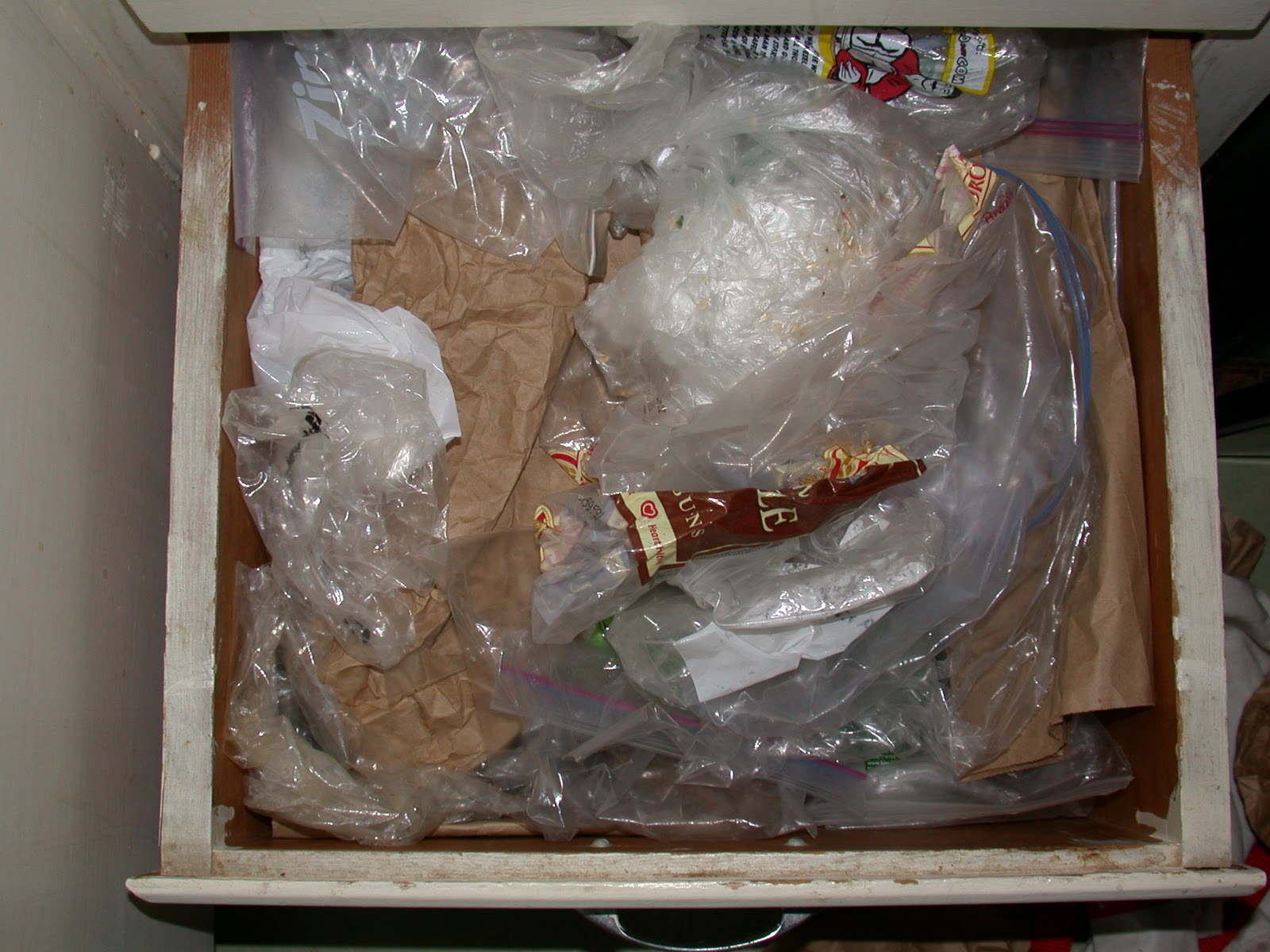
For one thing, if we treat them gently, the bags do last. For another, they continue to come into our lives even though we shun them. We have not taken one single virgin plastic produce or shopping bag from a store these past five months, but other people give us stuff in plastic bags, and we snag them from public places when we can see that they're not going to get recycled.
Saturday, January 22, 2011
Full Disclosure
We’ve added an item to the parameters – exceptions to the no-plastics rule -- and not for any profound reason except that we don’t want to give these things up: aseptic containers of soup and milk alternatives (the containers are waxed cardboard, but they have a small plastic cap.)
We’re both dairy-free; I put rice milk on my daily oatmeal and use it in place of milk in recipes, and Rick considers chocolate soy milk to be one of the four food groups (along with mustard, barbecue sauce and cookies.) As for soup, we both depend on it for our lunches. We don’t do sandwiches any more (sliced bread comes in plastic bags, deli meat comes in plastic bags) so soup is a less-plastic-laden alternative. I had lofty dreams of making homemade soup on a regular basis, but as you’ve probably perceived by now, I resist cooking, and I’m already challenging my resistance. I have been making some soups, but not enough to keep us well-lunched seven days a week. So there it is. If I were a better person, I would do things differently. But I’m not, so I don’t.
Friday, January 14, 2011
Pretzels
My very favorite snack in the world is one I’ve had to give up this year: big hard pretzels, the kind, as my friend Janet says, “that lacerate your gums when you bite them – God I love those.” The kind you can get in grocery stores around here are made by a company called Snyder’s of Hanover. I’m actually a member of the Snyder’s of Hanover Pretzel Eater's Club, which sends me coupons for discounted boxes of pretzels. Sometimes I daydream about taking a tour of the Snyder’s factory in Hanover, PA. Imagine the glorious smell! Imagine the free samples!
But of course, in the interest of freshness, the pretzels are packaged in a plastic bag inside their box, so I’ve been living without them for several months, and feeling deprived.
I’m also a great fan of the big hot pretzels you get at the ball park, and I consider them an able substitute for Snyder’s. But until recently there didn’t seem to be a way to get them in Portland without attending a ball game. Oh, there’s a place in the mall that sells them, but those aren’t real pretzels; they’re just pretzel shaped bread.
Then I saw an article in a local foodie magazine about a baker from Bavaria named Edgar who makes proper pretzels here in town. German bakers go through three years of training before they can be certified to make pretzels, so Edgar’s the real deal. The article said that he only sold his pretzels wholesale to other bakeries. But I was having a birthday, so my wonderful husband called Edgar up and asked if he would sell us a batch in honor of my special day. Edgar said sure. He baked me up a dozen pretzels and delivered them right into my greedy little hands fresh from the oven when we went to pick them up.

Aren’t they gorgeous?
Subscribe to:
Posts (Atom)