Wednesday, October 12, 2011

Our No-Plastics Year: Lessons Learned (and a Little Manifesto)


    The Unavoidable and the Avoidable

    Our No Plastics Year has come to an end, and it's time to reflect on the larger lessons drawn from the experiment. The past months have helped Rick and me see clearly the role of plastic in our ordinary lives. Every day, because we've been paying attention, we are faced with the fact that every material aspect of our daily existence is inextricably bound up in plastic. Even when we do not directly generate plastic waste, we rely indirectly on plastic-dependent products and industrial processes even to go about the simplest tasks. There is no way around it. But the experiment has helped us sort out the avoidable from the unavoidable.

I remember a few years ago our friend Pam committed to a period of living as a locavore – buying and consuming only food grown within a hundred-mile radius of home – to reduce the carbon footprint of her food consumption. She made many discoveries along the way that had not been at all obvious to her as a member of the general grocery-shopping public. For example, she learned that that while Oregon is a major cranberry producer, it is essentially impossible to buy Oregon-grown cranberries in the state. She also discovered that reading product labels was not sufficient: labels show where an item is processed, but not where its ingredients are grown. Experiments like these open our eyes to economic and infrastructural workings that are often invisible to us as consumers.

As I write – in a rustic wooden cabin in a forest setting – I am using a computer made partially of plastic, connected to a power source with a plastic chord, taking notes with a plastic pen in a notebook with a plastic spiral. I got here – and everything I'm using got here – in a car with plastic components, made in a factory that surely has many plastic components itself. I'm keeping off the chill with a fleece shirt; fleece is made of plastic. My shoes, my cell phone, my contact lenses and the saline solution they require – plastic is all around me, and this is just what I can see from where I sit. It is clear that we can live mindfully, but we cannot extricate ourselves from the modern world altogether and live a pre-plastic existence.

And in some ways it is a wondrous invention – so pliable and so versatile that its applications are almost without limit. It also occurs to me that in some instances, plastic may be a“greener” option than the alternatives. For example, plastic is much lighter than glass, so plastic food containers require less fuel to transport than glass ones. (My suggestion: eat locally!) And the jury still seems to be out on the disposable vs. cloth diaper debate: durable diapers go through an awful lot of water. (My suggestion: Don't have babies! Okay, touchy subject. I had a baby. I was even a baby myself once. Hey, some of my best friends are babies. Maybe a better bit of advice is “Have fewer babies.”) Plastic even has life-saving applications. I doubt any of us would want to return to the era of medicine that predated the invention of synthetic polymers.

At the same time, I see how wantonly, how frivolously, how thoughtlessly we use the stuff. There is no reason for every restaurant beverage to be served with a straw, for apples to be sold in clam shell containers, for fleeting squares of paper to be laminated. Single-use plastics, which comprise the biggest source of plastic pollution, are especially aggravating. Shopping bags, plastic utensils, straws, cups and lids, polystyrene takeout containers, and water bottles are all convenience items we can live perfectly well without. The damage they deliver is staggering compared to the tiny and transient moments of handiness they offer us.

The Damage Done

What is that damage? The question has been addressed exhaustively elsewhere, and I do not wish to publish a research paper here. I will just mention three big, obvious reasons that plastic is a problem.

  • Ocean health. By now most people have heard of the Great Pacific Gyre, one of five gargantuan vortices in the world's oceans that have sucked in thousands of square miles of plastic trash, dispersed and continuously photodegrading (breaking down into smaller and smaller particles of plastic) so that there is no easy way to clean it up. These and other collections of trash are killing marine life at an alarming rate. And of course, these plastics can make their way up the food chain, threatening us as well as all the other life they encounter.

  • Landfill space. Plastic is probably safer in the ground than above it. But landfill space is of course not unlimited nor impermeable. Plastics can poison water tables when city dumps leach contaminants. And when space is short, many plastics end up being shipped to third-world countries and burned for fuel – an air-polluting process that poisons many communities and harms other living things.

  • Human health. Of course, the health of the land, water and air around us affects human health. Plastic is also entering our bloodstreams more directly from the products we use. Ubiquitous plastics such as phthalates leach from containers into our drinking water and food. Phthalates are powerful endocrine system disruptors, implicated in such health problems as miscarriage, obesity, Type II diabetes, numerous cancers and genital malformation.

    It seems reasonable to suppose that the research results are only starting to show up. We will likely learn more and more about the dreadful havoc that these chemicals can wreak. And the longer we go on living with the stuff, the greater and more awful its impact will be.

The Way Forward

In a summit meeting of two in September, it didn't take long for Rick and me to decide to keep on keepin' on with our low-plastic living. We don't have the stomach to return to pre-experiment consumption habits. Of course, household objects and personal electronics will wear out and need to be replaced. We will continue to travel. Plastics will wile their way into our lives because we cannot find alternatives and are unwilling to live without certain technologies and conveniences. But we are living, and intend to keep living, without a steady stream of the stuff coming in. (We did decide to abandon the cloth diapers – too hard on the washing machine – and have returned to paper – but to rolls wrapped in paper, not plastic.) The easiest place to shun plastic is in the grocery store, where we shop almost exclusively in the produce aisle and meat department: everything is bulk, taken from the store in paper or re-used bags from home. Other consumer goods, like clothes, we try to find second-hand before we consider buying them new. 

Rick and I have been trying to live in a low-impact way in part because it's simply the right thing to do, whether or not our efforts have a measurable impact. In this sense, our endeavor to live with little plastic is almost a spiritual practice. It has to do with wanting to keep a clear conscience, with living out a commitment to doing as little damage to the environment as we know how. Beyond a small pile of trash we didn't make, and a little peace of mind we did, what good came of the experiment? Writing and speaking about it – publicizing it – has been an important component of our no-plastics year. (This will be my last blog entry on the subject, but we've been invited to speak publicly on how we live, and will probably continue to accept speaking invitations for some time.) We are contributing to a stream of voices from around the country and around the world calling attention to the problem of plastic. The blog has inspired a couple people to try to carry out plastic-free living of their own, and inspired quite a few more to examine their own habits and cut back on their plastic consumption where they can. The amount of plastic discards these friends and acquaintances actually avoid may be immaterial. What is more important is the shift in thinking that comes with mindful consumption, because only when a critical mass of us begins to demand alternatives will our political leaders pay attention.

Our society uses plastic as though it were harmless, when in fact it has a very grave and irreversible impact on both human health and the health of the greater environment on which we all depend. We would like to see society reserve plastics for truly important functions, and stop putting it to silly uses. When, where, what and how it should and should not be used is a local, and national, and international dialogue we citizens need to be having. And after the dialogue – regulation. 

Here's the kicker: humanity needs to start using plastic in a fiercely discriminating way. But this discrimination will not be achieved one household at a time. The accumulated plastic Rick and I have avoided this past year – a truckload, perhaps – is absurdly negligible compared to the monstrous amount our nation (and other nations) generates. The two of us can't make a dent in that mountain. The efforts of everyone who cares about this issue can't make a dent in that mountain. The dent can only be made at the level of policy and of law. It can only be made by governments, and our most important work, as environmentalists, is to command the attention of our governments, and induce them to act on behalf of the highest good.

Sunday, August 7, 2011

Un problema

I thought our substituting diapers for toilet paper was one of my more brilliant innovations (though it makes a surprising number of people feel squeamish to hear about). But in the end we may give it up. Here’s what’s happening: the diapers fray and hundreds of little bits of fabric and threads end up in the laundry sink, where they gum up the works and cause the sink to overflow. Last week I spent some time cutting off the frayed ends of the diapers – I call them frayzles – to see if that helps. What else did I have to do on a Saturday night?

Saturday, July 9, 2011

Washed Ashore

Sea stars, fish, sea turtles, jellyfish and coral are among the marine organisms most affected by plastic pollution in the oceans. A recent, striking art exhibit calls attention to the problem. Called “Washed Ashore,” this touring exhibit includes giant sculptures of sea creatures assembled from plastic rubbish collected on Oregon's beaches. Lead artist Angela Haseltine Pozzi and scores of volunteers gathered the trash and built the sculptures, which are both spookily beautiful and appalling.

Plastic is a severe problem for ocean dwellers, who often mistake the colorful bits for food. Floating plastic bags look to turtles like jellyfish, their main food source; fishing gear gets tangled in reef organisms and chokes them. Plastic does not biodegrade, ever, but it does photodegrade – that is, break down into smaller and smaller pieces that remain, chemically, plastic. These tiny, colorful pieces get swallowed up along with or instead of plankton by fish and sea birds.

Sometimes the plastic is enough to kill an animal on its own – as many as a million sea birds and 100,000 mammals each year (1) – who choke or starve when they eat our plastic garbage. But plastic also kills another way, by acting as a sponge for waterborne contaminants. PCBs, DDT and other toxins concentrate in polymers and then make their way up the food chain, affecting all the animals – including us – that ingest them.

Though some 11 billion metric tons of plastic makes its way to the ocean each year (2), Haseltine Pozzi notes that the red plastic used in her fish sculpture is the “most difficult to find washed ashore, as research shows it is the color of plastic most often mistaken as food by marine creatures.” (3)


  1. http://www.washedashore.org/

Friday, April 8, 2011

Why Not Just Recycle?

We have passed the halfway mark of our experiment, and my blog entries have slowed to a trickle because we've stopped encountering fresh difficulties in our quest to eliminate most plastic from our lives. We've solved most of our day-to-day plastic problems and discovered most of our workarounds. It's time for me to begin addressing the larger issues surrounding the Experiment – the institutional and cultural changes needed to address the problem of plastic, and why they matter.

When Rick and I first started talking about doing this year of no plastics, a friend said to me, “Why not just recycle?” It's an excellent question, and emblematic, I think, of where we are as a society in our thinking about waste.

If environmental awareness is a spectrum, we've advanced, as a culture, some distance since the beginning of the throwaway culture. We're past, for example, those television ads of the 1950s that touted the advantages of newly-developed disposables by showing fishermen dropping empty beer cans into a lake.

In the 70s we were taught not to be litterbugs – not to fling our fast food bags out the car window, but to throw them away. But where is “away”? As a child I thought our cities simply built their landfills in places where there wasn't “anything else.” You see the problem with that idea.

Recycling came along about that time as well, and forward thinkers began to practice it, though it required extra time and attention to sort, clean and transport recyclables. Rick developed a reputation as a vigorous recycler more than thirty years ago. I started recycling with gusto in the early 90s.

At some point the bigger cities introduced curbside recycling, and every few years the system gets better: more products are accepted, a greater variety of materials can be co-mingled, recycle bins get bigger and garbage cans get smaller. Conscientious urban citizens recycle, feel good about themselves for doing so, and look with disdain on people who don't follow suit. So what's the problem? Here are a few considerations:

  • Not everything that is recyclable is recycled. Manufacturers who use virgin plastic put recycle arrows on their products precisely because they want the public to perceive plastics as harmless. But the presence of the symbol on an item doesn't mean that the person who buys the thing has access to a facility that takes it – or has the patience to find out what can and can't be recycled and to do the right thing. Many communities still do not have even basic recycling facilities, and many others have no curbside pickup. Sometimes there are no facilities because recyclers can't compete with manufacturers who use virgin plastic. There has to be a market for recycled items in order to complete the loop.
  • Recycling is not a waste-free process. It takes fossil fuels to transport recyclables and to run the machines that sort and remake the items. Recycling also requires inputs of fresh water.
  • Plastic (unlike aluminum and glass) is only partially recyclable. It degrades in quality as it moves into its next life, and so each recycled plastic item must also contain some virgin plastic. Often the new items are not recycled, but rather downcycled into things like bumper stickers whose next stop will be the landfill.
  • Many items that are destined for recycling don't make it through the process. They get lost en route; they're taken out of the mixture because they're too dirty; they get jammed in machines.
  • A large percentage of our plastic recyclables (as well as paper) is shipped overseas, a process that requires stupidly huge amounts of fuel. Moreover, it is sometimes not “recycled” at all, but burned to generate electricity. Imagine the emissions from the smokestacks of unregulated electric companies burning plastic shopping bags in India and China, and the health impact on the people living there.

On the spectrum of practices representing degrees of environmental awareness, recycling falls some distance from the one end, where we find, say, Love Canal. But it also lies quite some distance from the other end, which represents sustainability. We are not going to be able to recycle our way out of our environmental problems, and those of us who do recycle should not feel too self-congratulatory about it.

Recycling is important and necessary, but only for those plastics that are unavoidable. For the others, a better practice is DON'T BRING THEM IN THE DOOR IN THE FIRST PLACE.

Friday, April 1, 2011

Bag It

A couple weeks ago Rick and I rode our bikes to the screening of a new documentary film called "Bag It" about plastic and the problems it causes. In true Rick and Jan fashion, I left the theater feeling buoyant because the film affirmed so much of what we are doing, and Rick left feeling downcast about the state of the world. You can decide for yourself how you feel about the matter. Here's the trailer:

http://player.vimeo.com/video/5645718

Saturday, February 19, 2011

Feral Bags

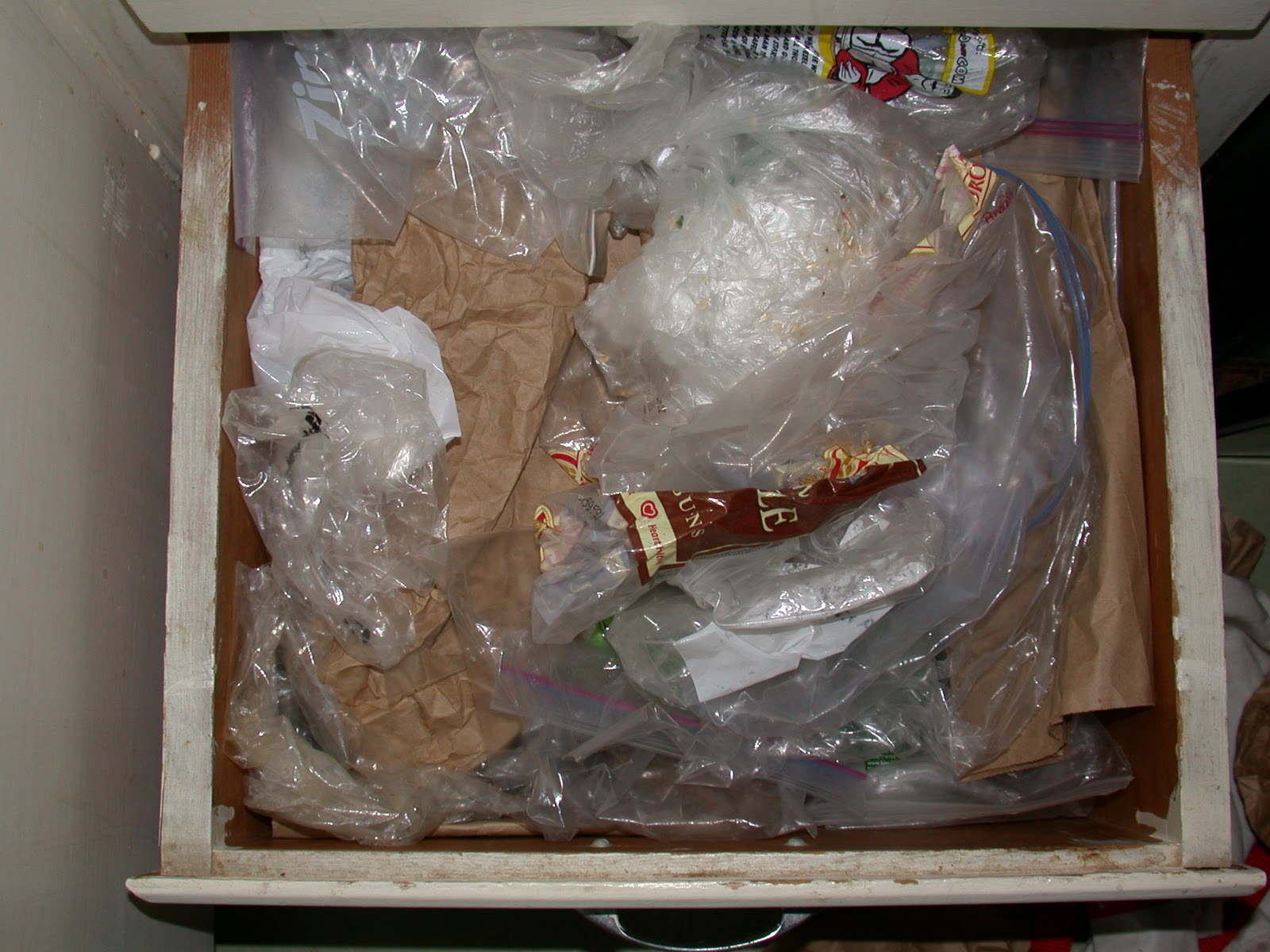
When we first began The Experiment, we imagined we might run out of re-usable plastic bags at some point. They can only be washed, dried and stuffed into a kitchen drawer so many times, we figured. But we've just passed the five-month point of our year, and our kitchen drawer is as crammed as ever.

For one thing, if we treat them gently, the bags do last. For another, they continue to come into our lives even though we shun them. We have not taken one single virgin plastic produce or shopping bag from a store these past five months, but other people give us stuff in plastic bags, and we snag them from public places when we can see that they're not going to get recycled.

Also, they multiply in the night of their own accord. Plastic bags need to be spayed and neutered.

Saturday, January 22, 2011

Full Disclosure

We’ve added an item to the parameters – exceptions to the no-plastics rule -- and not for any profound reason except that we don’t want to give these things up: aseptic containers of soup and milk alternatives (the containers are waxed cardboard, but they have a small plastic cap.)

We’re both dairy-free; I put rice milk on my daily oatmeal and use it in place of milk in recipes, and Rick considers chocolate soy milk to be one of the four food groups (along with mustard, barbecue sauce and cookies.) As for soup, we both depend on it for our lunches. We don’t do sandwiches any more (sliced bread comes in plastic bags, deli meat comes in plastic bags) so soup is a less-plastic-laden alternative. I had lofty dreams of making homemade soup on a regular basis, but as you’ve probably perceived by now, I resist cooking, and I’m already challenging my resistance. I have been making some soups, but not enough to keep us well-lunched seven days a week. So there it is. If I were a better person, I would do things differently. But I’m not, so I don’t.

Friday, January 14, 2011

Pretzels

My very favorite snack in the world is one I’ve had to give up this year: big hard pretzels, the kind, as my friend Janet says, “that lacerate your gums when you bite them – God I love those.” The kind you can get in grocery stores around here are made by a company called Snyder’s of Hanover. I’m actually a member of the Snyder’s of Hanover Pretzel Eater's Club, which sends me coupons for discounted boxes of pretzels. Sometimes I daydream about taking a tour of the Snyder’s factory in Hanover, PA. Imagine the glorious smell! Imagine the free samples!

But of course, in the interest of freshness, the pretzels are packaged in a plastic bag inside their box, so I’ve been living without them for several months, and feeling deprived.

I’m also a great fan of the big hot pretzels you get at the ball park, and I consider them an able substitute for Snyder’s. But until recently there didn’t seem to be a way to get them in Portland without attending a ball game. Oh, there’s a place in the mall that sells them, but those aren’t real pretzels; they’re just pretzel shaped bread.

Then I saw an article in a local foodie magazine about a baker from Bavaria named Edgar who makes proper pretzels here in town. German bakers go through three years of training before they can be certified to make pretzels, so Edgar’s the real deal. The article said that he only sold his pretzels wholesale to other bakeries. But I was having a birthday, so my wonderful husband called Edgar up and asked if he would sell us a batch in honor of my special day. Edgar said sure. He baked me up a dozen pretzels and delivered them right into my greedy little hands fresh from the oven when we went to pick them up.

Aren’t they gorgeous?

Friday, December 24, 2010

A Low-Waste Noel

It being Christmas, we had to have cookies, and their being cookies, they had to be chocolate chip. But chips come in a plastic bag! So this week found me on the kitchen floor with a hammer, smashing a one-pound bar of Trader Joe's 71% dark chocolate into bit-sized chunks. They made very toothsome treats.

The season has brought other quiet pleasures as well. We set the alarm and got up at midnight to watch the lunar eclipse the other night, but because we live in Portland, our plans were foiled by cloud cover, so we went back to bed and enjoyed the eclipse on Youtube the next morning.

Later that day, at precisely 3:38 p.m., we went out (teeth chattering) to the back yard and lit a tiny fire in our Mexican chimenea to observe the winter solstice. We stood out there just long enough to listen to the appropriate segment of Vivaldi's Four Seasons on my cell phone.


And I've been repurposing items from the recycling bin, making tree ornaments from spaghetti jar lids (they make nice round metal picture frames) and old cardboard and magazines and popsicle sticks and aluminum pot pie pans. Our tree is newly graced with images of Piglet, Pooh and Tigger; Olympic shot putter Michelle Carter; biologist E.O. Wilson (my hero); and Lady Gaga.

Sunday, December 19, 2010

Mauled by Malls

Last week we traveled to Tucson to check in on after Rick's mother, who is 91. Margaret is a dear soul for whom we would do anything. Anything, in this case, included leaving our political values at the shore and wading neck-deep into Retail America.

Tucson's city center is a place of considerable charm, with historic architecture, small businesses and a well-developed community of creatives. Out beyond the downtown core, however, are miles and miles and miles and miles and miles and miles and miles of indistinguishable strip malls, which we crisscrossed again and again as we searched for watch batteries, large print books, sun visors. We put 600 miles on our rental car and never left town, doing our part to warm the planet and generating our own little mountain of trash at chain restaurants as we went.

The westering sun on the mountains, the saguaro cacti marching up the hillside, the jack rabbits and javelinas at our campground were an insufficient antidote to the driving and driving and driving and driving and driving and the low-slung box stores stretching to the horizon and the open canals that carry water through the desert from the Colorado.

The sheer acreage of the sprawl, and the fact that most of it is dedicated to consumption, left us cranky and  homesick. Among the rotating Christmas trees and bobbing mechanical Santas, under the worst holiday hits ever recorded (hand-selected to be piped into every shopping center), I wanted to shake outer Tucson by the shoulders and cry THIS IS NOT CHRISTMAS. This is a horrible, joyless simulacrum of Christmas from which all inner peace has been siphoned out. This is acre upon acre upon hundreds of acres of pointlessness, each component of which has its own tiny zip-lock baggie, packed together with others in a plastic box and stuffed into a plastic shopping bag for its short trip from the mall to the landfill.

This may just be apocalyptic thinking brought on by nausea and crushing boredom, but on the other hand I could be right: in a hundred years, I think, there will be no Tucson as we know it. There simply will not be enough water and energy to maintain this grotesqueness. These endless miles of shopping opportunities will become a vast and trashy ghost town. And in a thousand years, what was once a 195-square-mile metropolis will be the site of an archaelogical dig, revealing layer upon fascinating layer of a strange and incomprehensible ancient culture.

Tuesday, December 7, 2010

Bad News, Good News

The Experiment is humming along, so well that I worry about running out of things to write about. Within the parameters, it’s been surprisingly easy to eliminate plastic from our lives.  And without the parameters, it would be impossible.
I’ve flown out of state twice since my plastically-disastrous trip to Key West in October, and fared no better on either excursion. And here at home Rick and I had a plumbing problem that required going down to the crawl space under the house with a flashlight. A flashlight needs batteries, which aren’t sold in bulk; what were we to do, carry a torch to the cellar? (To his credit, Rick sought out and found minimally-packaged batteries, shrink-wrapped in sets of eight). Also, I spent my November freebie on a netbook – an extravagant use of a freebie, I think – because of a perceived (mainly professional)  need to be connected to the internet and have access to word-processing while traveling in and out of town. 
I think this may prove to be the main insight of the year’s experience: it is easy to reduce, but nearly impossible to eliminate, our modern dependence on plastic. To do so would require extreme effort, some measure of deprivation  and a monumental change in the way we go about being alive and human.  It would not present an imitable model, and we’d probably make ourselves obnoxious to our friends.
That said, we are finding daily life not much changed. We are not inconvenienced by our new regimen. However clear our dependence is, it’s also obvious to us that our society goes through much, much, much more plastic than is necessary, and it’s this wantonness that bothers us.  I might need prescription meds that come in plastic vials, but I don’t need a sword-shaped plastic stir stick in my black tea.  I might even need a netbook, but I don’t need a plastic bag to tote it home in (actually I was impressed by its minimalist packaging, mostly cardboard with a small plastic handle for carrying. You go, Asus.)
We’re not zealots – just committed, if slightly eccentric, people trying to draw attention to a mounting problem that we think could be at least mitigated with a little mindfulness.

Friday, December 3, 2010

A Close Shave

It's all about line-drawing, this business, and one place we've drawn a line is at shaving cream. It's available, of course, only in cans with plastic caps. Granted the can is metal, and it lasts a long time -- but still, if we were truly pure of heart, we would stop shaving altogether. But Rick feels scruffy in a beard. And I'm very uncomfortable with hairy legs and armpits. There's a good deal of demographic overlap between women committed to waste reduction and women who don't shave. I live among a people who tend to regard shaving as anti-feminist, unnatural and silly. Not I. Unshaven, I feel like a great stinking ape, especially in ballet class.

Research reveals that there is a whole community of "wet shavers" who use a boar-bristle brush and a special soap in a special bowl to work up a lather for shaving, like in cowboy movies. Who knew? But those brush handles are probably made of plastic (unless you get a high-end porcelain one. Does one really need a high-end shaving brush?) I also have concerns about taking bristles from boars. Not to mention the time and space commitment involved.

We could be truer to our cause, and live in solidarity with the homeless, the women's movement, and the endangered boars. Instead, we draw a line.

Saturday, November 13, 2010

Sweet Tooth

In support of The Experiment, our friend Pam gave us several jars of homemade apple butter, and my parents came home from a trip with homemade jam for us in assorted Southwestern flavors like choke cherry and jalapeƱo. Jam has been a sticking point, as it were, because most commercial jars of sweet spreadables, though glass, come with a plastic seal around their necks. And because Rick has a considerable appetite for the stuff. A bagel is really just a way to get jam from the jar to his mouth.

Rick's other source of suffering is cookielessness. Cookies, a staple, invariably come in plastic packaging of some kind, unless you get them from a bakery. But at a buck or more a pop, bakery cookies could not satisfy Rick's hunger. At his rate of consumption, he'd have to choose between cookies and health insurance. 

His lovely wife actually made cookies at home last week, and they were darned good, too. But that might have been a fluke. Rick has hit on a brilliant solution. He's compiled a list of all the commercial venues in town he frequents -- the woodworking supply store, the credit union, the vet -- that leave out plates of cookies for their customers. He can address his appetites when he's out running errands. He will not suffer from insufficient Vitamin C, or Vitamin J, either.

Sunday, November 7, 2010

Keeping it on the Merry-Go-Round

Of course we have always recycled. Both Rick and I are decades-old recyclers who've been gathering and sorting and storing and carting off bags of miscellany since long before curbside was invented, since long before recycling was de rigueur. More recently, for a short, sweet time, we were squirreling away goodies for a local company that took all the plastics not recyclable anywhere else in town, the cereal box liners and the styrofoam cups and the sad old toys. That company would hold an event three times a year in a church parking lot, and swarms of plastics hoarders -- our people! -- would show up with bags and bags and bags of weird shit they'd been keeping in their laundry rooms for the occasion. Then the economy crashed, the bottom fell out of the plastics market, and there is no tri-annual Plastics Round-Up any more. We've still got a stash by the freezer; we're hanging onto it with a kind of messianic hope.

Still, for all that deeply observant recycling, there were always things we had to put in the trash, things that no one, not even the Plastics Round-Up people, could take. Vinyl, for one. And misceginations of plastic and metal that couldn't be pried apart. So I am happy to report that The Experiment is reducing the number of those deadbeats under our roof. I can't be scientific about it, because we aren't (unlike an even more observant anti-plastic blogger we know) cataloging all the synthetic polymers that darken our doorway. But we're generating less that is landfill-bound than before The Experiment started. For at least a year, our household has been producing about three-quarters of a (standard 32-gallon) can of garbage each month. Last week when I went to put the garbage out, it being the first of the month, I discovered we'd only filled up half the can. Safe to assume at least some of that volume can be accounted for by yucky plastics no longer passing through our hands.

Don't be too impressed. We know people who produce just one can of garbage a year.

Sunday, October 31, 2010

A Retraction

I was confused! Don't start sending old toothpaste tubes to Tom's of Maine!


I don't know where I got the idea that Rick was mailing his empty tubes to the East Coast. I might have gotten them mixed up with Preserve brand toothbrushes, which come from the store in a pre-addressed package that you use to mail the old toothbrush to the company for recycling when you're done with it. Rick just takes the old Tom's tubes to our local recycle center. He chooses Tom's because the tubes are metal rather than plastic. This is what the Tom's of Maine website says about its toothpaste tubes:


Tubes: Recyclable aluminum
Cap: Polypropylene #5
Threading: LDPE #4
Box: Recycled/Recyclable paperboard -- 40-65% post consumer
Insert: Recycled/Recyclable paper -- 100% post consumer

Tom's contributes to all sorts of good causes, manufactures and packages its products as responsibly as it can, and treats its employees well. So it's a good toothpaste choice for a variety of reasons. We have some concerns about aluminum, which we've eliminated from our kitchen because of research linking it to Alzheimer's. But this is what we're doing at the moment -- at least for one toothpaste tube's worth of time.

Saturday, October 30, 2010

The Tyranny of Toothpaste, and Toilet Paper Redux

Our post on toilet paper attracted so much attention I thought I'd better address some of the points raised. Yes, we wash the diapers in hot water -- the only items in our household to get such laundry treatment. No, we don't cut them into to smaller sizes. We tried that, but the inner fibers unraveled in the wash and came out a tangled mess. We also discovered that the thickest diapers are actually too thick to be -- how shall I say this? -- sufficiently pliable. Thin diapers are better. No, we're not sure the environmental trade-off (plastic generation vs. water usage) is worth it (we're not trying to save the whole world -- not this year, anyway). And the ew factor is really nothing, guys. At the risk of over-sharing, I have to say that the nice soft cloth is rather an improvement over paper...

Pre-industrial ass-wiping doesn't bother me a bit. On the other hand, modern dentistry has, I believe, improved the quality of human life a great deal in the last half-century, and I'm not inclined to mess with it. We've been fretting from the start about toothpaste tubes. Rick found some recipes for homemade toothpaste on line, but further research cast doubt on its efficacy. Here's our compromise: Tom's of Maine brand toothpaste will take its used tubes back and recycle them. Rick's been sending his empty tubes back for years, so I am joining him in becoming a Tom's loyalist. The toothpaste is a little more expensive than Crest, but how much toothpaste do you go through in a year? And should I raise a complaint about Wintermint, the  only flavor they make their toothpaste-for-sensitive-teeth in, Rick is likely to respond: "Yeah. They don't have these problems in Darfur."

Sunday, October 24, 2010

That's How We Roll

We have hit on a solution to the problem of toilet paper that will don't imagine will attract many imitators. The problem of toilet paper being that the 6- and 12- and 24-packs come encased in plastic. We could, of course, buy rolls singly, wrapped in paper. But that's hard on the wallet.

So we've opted instead for diapers.

A local diaper service sells clean, second-hand diapers by the dozen for use as rags. We bought a stack and are keeping them in a basket by the potty. After use, they go into a lidded stainless-steel garbage pail, and from there to the wash.

I hear readers now going, "Eeeewwww..." We are a squeamish people, we Americans. We want our caca to disappear on sight. But really, this new system is no weirder than using cloth diapers with a baby. It's a lot less grody than cleaning a cat box. It's cheap, it frees up space in the linen closet, and it produces no plastic waste.

And we get bonus points for saving trees.

Wednesday, October 20, 2010

Something of a Disaster

I've just returned from a conference in Key West, and have many Hail Marys to say, because although the conference was a great success, The Experiment completely went spla. Parameter # 6 states that we will cut ourselves slack while traveling, but I thought I could do better than I did.

Things fell apart as soon as I hit the airport. I bought my usual airport treat, a cup of tea and a scone at a certain well-known coffee chain, specifying that I did not want a lid on the cup. That message failed to get through, and when I called it to their attention, the baristas refused to remove the lid and reuse it, even though I had not touched the cup. I could see that a manager had put the fear of the State Public Health Division in them.

During my layover in Dallas-Ft. Worth I chose to eat lunch at a restaurant specifically on the basis of the pretty pictures showing food served on real plates with real cutlery. But when the food arrived, it was served on plastic with a plastic fork and knife. And a straw -- ARGH! -- in my drinking water.

My conference was in a resort and so all the meals and drinks there were served in durables. But Friday night we went out on the town, and the Margaritas arrived in plastic cups.

Finally, I spent an afternoon walking around town sightseeing in the pouring rain, and my sneakers got incredibly stinky. I dried them out and tried to freshen them up with a bit of soap, but to no avail. They were too foul to wear on the way home, and too foul to stuff into my suitcase with my good clothes. So I wrapped them in a new plastic laundry bag.

I did bring every bit of plastic I'd used home to recycle -- yes, carrying my used Margarita cup with me everywhere all evening on Friday -- but it was painful to lose control of The Experiment so thoroughly. I just have to keep muttering to myself "Parameter # 6, Pararmeter # 6, Parameter # 6."

Tuesday, October 12, 2010

Drawing a Line

For several years now I have subscribed to a certain women's fitness magazine. I like it all right: the healthy-eating tips, the workout how-to's, and the encouragement to keep on keepin' on are all mildly useful and make for good, lite reading on the treadmill.

But. These magazines are chockablock full of ads for -- can I just call them what they are? -- stupid plastic shit nobody needs. Hair smoothers. Wrinkle hiders. Pre-packaged snack foods. In my most recent issue, which is 210 pages long, I counted 151 pages partly or entirely devoted to ads, and another 29 pages of health and fitness "articles" that promote specific products, complete with photos, urls and celebrity endorsements. It's safe to assume the manufacturers pay for these product placements.

I understand that magazines turn a profit by selling advertising space. But I feel bombarded, and suspicious of sales pitches masquerading as journalism. And I've been increasingly annoyed by the disconnect between the "health" that is promoted in the pieces and the mountains of garbage they encourage us to generate, especially since some of the publication is devoted to "green" living.

So recently when my subscription ran out, I declined to renew. Just as well: new issues were always delivered in a plastic sheath.

Sunday, October 10, 2010

10-10-10: Blogging for Social Change

Today we join tens of thousands of other writers, activists and concerned citizens for International Climate Action day, a day to raise awareness, pressure lawmakers and do something concrete to lower our ppm -- the parts per million of carbon dioxide molecules in our atmosphere that are trapping greenhouse gases and dangerously warming the planet.

Portland alone must have hosted half a dozen 10-10-10 events today. The one we chose to attend was a styrofoam recycling roundup at a local Episcopal church. We had a full carload of block polystyrene, hardly any of it ours -- Rick makes a point of picking it up when he sees it around town in dumpsters and recycling bins (the stuff isn't recyclable curbside here, but that doesn't stop some people from leaving it on the curb in their yellow bins). He keeps it in a friend's basement (thanks, Etienne!) and when he's amassed enough of it, he takes it to a recycler in town and pays $5-10 to have it recycled. But this event was free, and we liked participating in a community action.

What's the connection between styrofoam and climate change? Mainly, it's that plastic, like any product, takes energy to produce, and energy consumption almost always involves carbon emissions. So in addition to the environmental hazards that bookend plastic use -- on the one end, degradation involved in drilling for oil, from which plastic is made, and at the other end, degradation of habitat and endangerment to wildlife -- plastic contributes to the most pressing environmental issue of our time.

Of course, the production of all the alternatives to plastic also consume energy. Arguably it takes more energy to make glass, for example, than to make plastic, and it certainly takes more fossil fuels to transport glass than plastic because it's so much heavier. Glass, however, has a much longer shelf-life. Rick and I keep many of our glass containers indefinitely; pasta jars become jars for holding popcorn or rice (bought in bulk); mustard and jam jars get passed on to a friend who raises honey bees. Plastic tubs become leftover containers, but plastic quality degrades over time and eventually, out they go. There's a reason the words in the slogan "reduce, reuse, recycle" are in that order. Recycling is good, and we've been zealous and expert recyclers for some time. Reusing is better, and this is the part of the slogan where we are hanging out a lot these days. Best of all is not to buy stuff in the first place. That's the big challenge for the Experiment -- trying to lead a Make It From Scratch life in a pre-fab, single-use culture.

One thing that is already clear from our experiment is that there are no perfect solutions. Every choice involves a trade-off, and it's not always easy to measure our impact or discern which is the least of multiple evils. The best we can strive for is to be mindful -- to inform ourselves, make thoughtful decisions, and raise our voices together with those of other people who care.